
.jpg)
Interview
ephemeral objects is the artistic alias for Michelle La based on unceded traditional territories of the xʷməθkʷəy̓əm (Musqueam), Sḵwx̱wú7mesh (Squamish), and səlilwətaɬ (Tsleil-Waututh) Nations, also known as Vancouver B.C. VJ, DJ, producer, and educator, Michelle's experiments with immersive audio visual environments have earned her well deserved renown as a true sorceress in the Cascadian underground. Whether performing, leading workshops, or curating, her work combines passions for the organic and ethereal with an academic aptitude with the goal of expanding accessibility and envelopment within artistic settings.
Michelle has released music on PPRZ, Wuji, SYS Sister Sounds, and Bass Coast Music, and is also one half of the A/V and DJ duo i+eo in collaboration with iha. Additionally, she is a resident of Acceleration Radio, an open format FM radio station, live stream, and events collective focusing on A/V experimentation.
Can you share your process for curating visual accompaniment for a music experience, be it a combined A/V set of your own, or as the VJ for other artists?
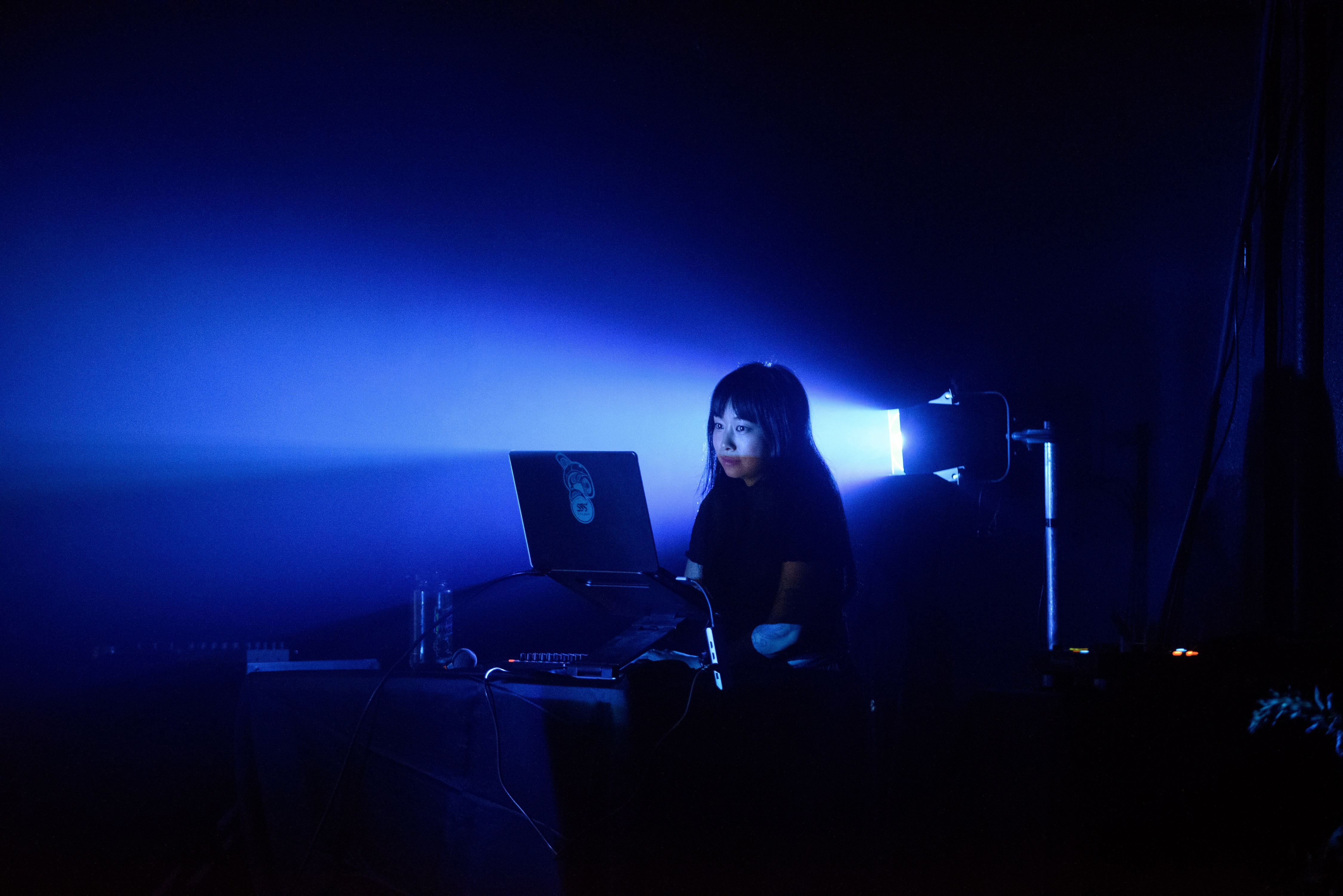
I see my practice as visualizing sound, translating what I hear into visuals – hopefully amplifying the embodied experience of being at a show. For me, it starts with listening. I try to connect with the feeling and internal logic of the music. When I’m preparing for a show, I research the artist’s vibe and the energy of their music. I think about the context: the environment, projector, the lighting, and the audience. I curate a library of visuals that I limit myself to for the performance. My visual language tends to be dynamic, abstract, psychedelic, and colourful. I’m always experimenting with new effects and content to keep the process interesting for myself. I make my VJ file for the show flexible enough for me to create and adapt during low- and high- intensity moments during a set. I map my MIDI controller and practice in VDMX6 Plus. Even when I’m performing the same video sources, I’m responding to the music as it unfolds, so every set is its own.
When I curate VJs or a/v performers, I want to show the audience different forms of live visual practices. So I make a point of including different approaches, whether that’s analog visuals, artists coding their own visuals, artists using multiple programs, or real-time in TouchDesigner. I think about whose style will best match the energy and vibe of the artist, reflecting upon the flow of the evening It's special when visuals can amplify our experience and help people connect with music in another way. Ultimately, I want the visuals to contribute to an immersive experience rather than just decorate the stage. I’m interested in how sound and image can alter our perception of time and space, and how they can draw people into a shared experience that feels outside of everyday reality.
What’s inspiring your work most these days?
I am a chronic music digger and go through moments where I am really into a certain vibe. Lately, I’ve been interested in experimental bass and downtempo (as reflected in my mix), and producers who occupy the spaces between these genres and techno mutations, like 5RVZ, Aa Sudd, and Brendon Moeller. I’ve been inspired by producers like Paperclip Minimizer, Katatonic Silentio, and Konduku for their sound design and what a groove can be. I’ve been drawn to music that can be hypnotic or immersive without necessarily following convention.
I have been really inspired by learning. Through Creative BC’s Demo Recording grant program, I’ve been learning from Veron Xio aka x/o to enhance my production skills in Ableton. Leaning on hardware in the past, I have been challenging myself to solely create in the DAW during our mentorship period. The more I learn about production, the more I understand what other artists are doing, which has been positively impacting how I listen to music and DJ.
I have been working on my live debut for Brain Bath, a series led by Pacific Rhythm and Fortress (shout out to Rai and Derek) on October 30th, where I’ll be playing a downtempo set, with Canadian icon Jex Opolis on the bill. I've been letting myself create freely and thinking about how to build a narrative – a through line – between my own original productions in my first downtempo performance. I've spent about three years watching people perform live with all kinds of gear and setups, so I am excited to start performing live. I've been fortunate enough to go to MUTEK Montréal for the last three summers in a row. It's one of the most inspiring festivals I've been to for seeing live performances, whether music or visual works.
My background is in anthropology, so I am always thinking about context and unspoken norms, structures, and power. Lately, I have been reflecting and thinking about connections between DJing and academic scholarship. As a scholar or researcher, when you write a literature review or a thesis, you map the conversations and ideas that others have had before to inform the present. I have been thinking about how the practice of DJing with intention could be viewed in a similar way. Particularly, how can a DJ’s curation help shape the dialogue of music within their set? Everyone’s actions and choices shape culture, so how are we shaping the culture of music through our selections?
What are some of your favorite things happening in Vancouver right now?
What excites me most is the persistence of Vancouver's underground scene. Over the last year, a lot of underground spaces were cracked down on by the Vancouver Police Department. I think it has (re)ignited our underground, making us feel more connected, politically aware, and savouring the moments that we have together due to the fragility of our underground arts and cultural spaces. Vancouver’s municipal government has a history of being hostile to the underground, so this is also not a new thing for us. However, I feel hopeful these days because of people's resilience and determination to mobilize, scrutinize who is running the city, and vote accordingly in our municipal election this month.
Sometimes we are spoiled by choice, where it can be hard to make a decision on where to go on a weekend because there are so many good shows. I'm seeing a lot more thought and care going into productions, where crews are paying more attention to environmental elements, whether that's installations, visuals, performance art, lighting, or decorations, such as the party series Nymph Nouveau, Vertical Migration, Friction, teXture, Dolly, and Obstructed View. In the collective Naga, which I'm part of with IHA and Xiumei, we also throw multidisciplinary parties with more immersive environments, and have been incorporating more live performances too.
I’m also excited to see more DJs getting into production and more artists performing live or developing hybrid sets. You don’t have to produce to be a DJ, but it’s exciting to see people becoming more confident in expressing themselves through their own sounds. I am seeing more people using TouchDesigner to create new media art with the help of our enthusiastic TouchDesignerYVR community. Vancouver is isolated from larger Canadian cities like Montréal and Toronto. We also have the highest cost of living in Canada, inadequate arts and culture funding and infrastructure, but despite that, we still have a lot of really talented people and crews that I believe deserve to be known about.
You were recently on a panel for Public Disco discussing the people, spaces, and conditions shaping the B.C. underground. Can you share some of the content of the panel?
The panel was called Parties Build Cities, part of Public Disco’s Industry Exchange at the Polygon Gallery to commemorate Public Disco’s ten-year anniversary, a non-profit working at the intersection of music culture and public space in Vancouver, activating public spaces. The panelists were cultural producers and artists, including Elsa Sainas, Nancy Lee, Brenodcha, Paige Frewer, and it was moderated by Cazimi Houdini. The focus was on panelists' stories of how and why they became involved in Vancouver’s underground, the current conditions and challenges shaping it, and the future we hope for.
I shared about how I got into this world in the first place. In February 2022, I watched my partner Laine Butler VJ at a Public Disco show and ended up taking over his controller for part of the night. I became completely obsessed, started making my own visual content in TouchDesigner, and played my first VJ show at Fountains Festival in November 2023. That was the first time I felt like a contributor to the scene rather than just a consumer.
We also talked about what makes a scene possible beyond the music itself and the challenges, such as the immense risks of throwing a show, the lack of accessible spaces, and being around people who may not have the best conflict-resolution skills. There’s so much invisible labour involved in sustaining an underground, from organizing, documentation, the consistency needed to develop a following, and it's become even more challenging with the lack of space and high venue costs.
Financial accessibility was another important part of the conversation. Ticket prices matter, but so does public transit that runs late enough for people outside Vancouver proper to get home after a show without it being cost prohibitive. Otherwise, people with the cultural, social, and economic capital to live in the city centre have the easiest access to DIY spaces. That shapes the conditions for who gets to participate in the scene in the first place.
More on that, what do you feel the scene could use more of, and what do you think it could use less of?
On the panel, we spoke about more collaboration between crews, more intentional and risk-taking curation, where the party develops a journey, and more spaces to play different tempos and genres of music (e.g. ambient, downtempo). If crews could share resources and audiences, it would make it more feasible to take those risks and bring people here who wouldn’t otherwise come through. There’s also so much talent in Vancouver from the film, VFX, animation, and video game industries. I’d love to see more cross-pollination between those communities. There’s so much potential for collaboration, especially when it comes to co-creating audiovisual works and immersive experiences.
While gatekeeping protects our scene, it is a double-edged sword. This creates conditions that foster cliquishness, which makes it difficult for people to enter and participate in our scene, especially if opportunities keep circulating within the same networks. I want to see lineups that actually reflect the city we live in. More than half of Metro Vancouver’s population identifies as a visible minority, but you wouldn’t necessarily know that from a lot of lineups. I want to see more than a surface- or tokenized- level version of diversity, where the promoter thinks they have achieved diversity through booking pretty much only cis-white women.
Stylistically, you’re quite wide ranging in terms of selection - exploring techno, ambient, downtempo, bass music, and more - seemingly limiting yourself as little as possible. What is the unifying factor of your productions and selections overall?
I think the unifying factor is less about genre and more about how the song makes me feel. I’m drawn to music that creates an atmosphere you can inhabit, whether that’s a slow, ambient piece or something more driving and propulsive. I love when a rhythm or texture becomes hypnotic, and small changes start to feel significant because you’ve spent time inside the sound. I have been a voracious listener of music since childhood, and I never limited myself in what I allowed myself to enjoy. I’ve had phases of being obsessed with different realms of music, including J-rock, baroque, Belgian electro, rap and hip-hop, classic rock, techno, and footwork. I feel that my approach to music today is an extension of that.
When I DJ, I am interested in discovering connections between music, whether that’s through a shared texture, energy, feeling, or the way a track creates tension and space. I feel the most creative when I can think about worldbuilding through sound rather than being constrained by genre. I look for music that is surprising, evolving, beautiful, haunting, cunty, or cataclysmic – whatever keeps me locked in. I’m also interested in the spaces between, where the lines blur, and producers who create a sound of their own.
This sensibility also carries into my own productions, where I’m exploring the relationship between rhythm, atmosphere, and texture. I might start thinking that I'm going to produce a techno track, but it may end up being experimental bass at the end. When I produce, I think about whether the sounds belong together in the world I’m trying to create. If my music does not neatly fit into a genre, that is more interesting to me. I want my sets and productions to leave room for discovery, both for myself and for whoever is listening.
.jpg)
Tell us a bit about your mix!
For this Peace Portal mix, I was feeling spacious, spectral, and introspective. A downtempo journey through ambient and shadowy dub, with moments that are bass-forward, dreamy, tactile, and sometimes very minimal. I wanted to bring together artists working across this spectrum spanning the early 2000s to the present. I start the set with a track from Swedish producer Stress Assassin’s album Within the Office of Eye and Ear, originally released in 2003. A stunning ambient dub find that I discovered through Bandcamp. I included tracks by Microbe, Pavel Ambiont, and Kriipis Tulo, electronic underground Belarusian artists from 2003-2013 that I discovered on the Internet Archive while digging for this mix. These artists and tracks really surprised me because they truly sound timeless and could have been released today. It was also a reminder for me how the love and impact of dub is cross-cultural, all thanks to Jamaican sound system culture.
There are also a lot of very newly released tracks from this summer, including a couple from appendix.files’s APPX: Friday's Comp 02 and a track by NeWRoomfreaK, a new alias by Vancouver legend Hashman Deejay. The mix also features ‘whirlpool’, an unreleased track of mine that’s set to appear on an upcoming Delusional Records compilation with a vinyl release, which I’m really excited about. This set reflects what I love about DJing: finding music from different places and periods that speaks to one another, even when the artists might never have imagined their work sitting alongside each other. I’m always looking for those connections, and for music that creates a world you can get lost in.
For more from Ephemeral Objects, follow her here:
https://www.ephemeral-objects.com/
Resident Advisor
Soundcloud
Instagram