
Interview
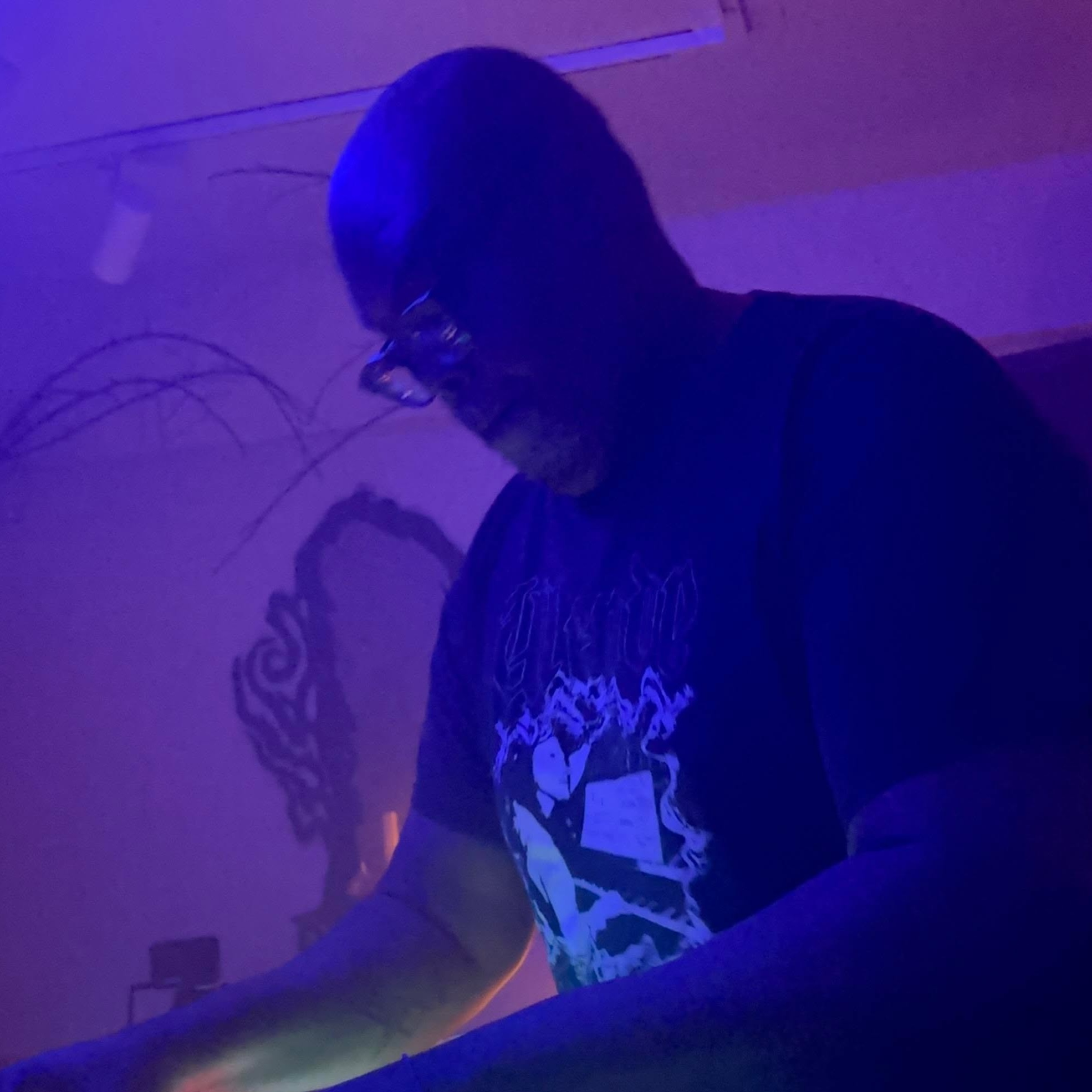
Production Unit Xero is the vessel for Portland-based Ramon Mills’s audio experimentations. Ramon occupies a realm of his own entirely, constructed through rapid transit of sonic material to the farthest reaches of space. Few are so prolific in the PNW.
Peace Portal first encountered P.U.X. at his home studio, which serves as HQ and mothership for his label, Heterodox Records. Celebrating 20 years of transmission through Heterodox later this year, Ramon has surrounded himself with an intrepid crew of aural explorers, responsible for 136 releases and counting.
Beyond the Heterodox catalog however, he has also shared his knowledge with the collective conscious through community link ups focused on improvisation and investigative production. Additionally, Ramon is a Roland VST developer, tabletop RPG architect, and gnostic techno philosopher. A wizard with many tricks up his sleeve, Peace Portal is pleased he’s agreed to demystify several here.
First of all, congratulations on 20 years of Heterodox this year. I’m curious if you can share a bit of the history leading to this point?
Oh boy, this is a big one. The first thing that popped into mind is; I remember being 20 or 21 in Gainesville, Florida in the early 2000s and collecting burnt CDs of people’s original music and I thought that was the most amazing thing in the world that I could have all of this music made by people that I know that showed parts of their personality. It felt really intimate and special and at that point, I just wanted to have a whole CD binder full of just music that people that I know have made. That led to meeting more people, collaborating, talking about music, and a couple of failed and premature attempts to start a record label here and there with various groups and people.
Then in 2004, when I lived in Asheville, North Carolina, I sent out a bunch of demo CDs to various labels around the world and I didn’t hear anything back. Later, I found out that didn’t mean that people weren’t listening, but it wasn’t the best time to try to get art representation in music, as the MP3 Music industry apocalypse was happening.
So I realized that I was around a ton of talented artists in my friend group around Asheville, my friends from Florida, and the people I was meeting on Myspace…I can start my own label. And in 2005, Heterodox Records was born.
It started off as a four way split EPCD, so four artists each with a four track EP on a single CD. The first was called Heterodox EP Compilation Alpha and it featured myself, my good friend and the earliest person I knew who was making electronic music before me, Jeremy Turon, who at the time went by the name of Circumference, he currently produces as Bag of Holding. And then there was Quetzatl, Esiris Lyons, from Asheville, North Carolina. He was one of my major collaborators in that area, and he was also starting his own label Waveform Modulations. He helped me a lot in the beginning, getting the initial CD together, planning and strategy, and he brought one of his collaborators who went by the name of Agent Woo. And that was our first release. We printed that on a short run of 100 CDs in jewel cases.
That started the first wave of Heterodox Records, based in Asheville. We went on to make three EP compilations and release several CDs from myself, Circumference, Quetzatl, and other artists. That flow lasted until 2010, when I released the last batch of CDs for Heterodox Phase One. By that time no one was interested in CDs at all, so all of the CDs that I made sat in my closet.
Instead of dropping the label altogether, I moved everything to a Heterodox Records Bandcamp and became a net label even though I hated that term. I felt like at the time it was an attempt to de-legitimize artists that didn’t have the money to drop on vinyl or more professional glass-mastered CD pressing. But I did it anyway, because I love music and I met lots of people from all over the globe, far too many to list here, and from 2010 until around 2017, Heterodox remained primarily a net label and we released lots of music, my goal was to release music from artists who in some way embodied individual expression and forward thinking art.
I moved to Portland in 2015, and, after being a part of a couple of music scenes that weren’t that friendly, I decided to just observe the scene, see what the temperature was, before I started moving inside of the scene. In 2016, I started playing shows, meeting people, and building what is the current era of Heterodox Records. This accelerated the growth of the label on the vectors of artists/roster, and reach/popularity. I have been blessed to have many artists in the Pacific Northwest share their music with me and we’ve made many compilations and done a ton of releases. At the time of this interview, we have 140 releases on band camp and many others that didn’t make it to the digital world on Bandcamp. Yet some of those albums have placeholders which, if you really dig through the camp, you’ll see that there are some gaps in our catalogue numbers. Those might appear later once I dig into the archive.
And as you say in your question, this is the 20th anniversary of the label, which is something I never really thought would happen, but I’m glad I’m here to celebrate it. I’m gonna kick up production of albums. I have a lot of stuff lined up. I’m doing a comp series this year. One will be the next installment of my series, Sonic
Adventurers Consortium, it will be the CD release focused on left of center dance music. I plan on releasing that in the Spring. Next will be the Heterodox 20th Anniversary compilation that will be a double disc release, hopefully in the late summer. We will close out the year with an ambient music compilation. There has also been talk of a more conceptual compilation where all of the players in my tabletop role-playing game world will make songs about the world and their characters. I’m not sure if that’s gonna get released this year, but it’s in the works.
Heterodox has always been about live performances. I played some of my first shows before drag nights, where a lovely human named Star, who booked at the University Club, in Gainesville, FL, saw potential in my music and gave me a gig in a time where people playing experimental weirdo music on laptops was not the norm or normally accepted. I continued playing shows in Gainesville, Florida, Asheville, North Carolina, Austin, Texas, and here in Portland. After the first lethal wave of the pandemic gave way to vaccinations, I decided to start booking my own shows here in Portland, and since 2021, I have promoted the events Cyberpunk Disco, Equalizer (EQ), and the Ambient Garden Parties. The show promotion time period of Heterodox has been awesome, organizing shows, helping new people in the scene get shows, and just the joy of community has been one of the high points of my life over the past five years.
Having had a glimpse into your process in preparation for our show together last January, I'm curious if you can share about your methodology? Where does improvisation end and production begin for you?
The first decade or so of my music making “career“ was done on the computer. It was experimental, but very little of it was improvisational. I used FL studio Sony‘s acid wave editors in a ton of VST plug-ins to compose music.
After getting a desk job in the music production industry where I helped musicians figure out their Software, computers, midi controllers, and audio interfaces all day, I got tired of focusing on the computer when I got home from work, so I slowly shifted my production over to live hardware. This began in 2011 or so. Before that, I had done some improvisation with the computer and midi controllers, but it was still a lot more structured. Like composition, broke up into smaller parts and rearranged and remixed. My hardware time led me to playing all of my own keys and pads, building beats on the fly with drum machines and sequencers, and getting way more into live knob tweaks and automation.
That’s the background. Now, the way that these things work together is; I improvise on my machines to create ideas, then I take all of those ideas and I perform them live into my DAW, Ableton.
Part of the mentality behind this process is that I had spent years and years writing music on a computer and at my live shows I ended up remixing my tracks live. There wasn’t much improvisation there, and there wasn’t much for me to do on stage.
When the live hardware time period started. I had 2 lanes. Lane one is writing songs; using all of my gear to make pieces and put them together. Lane two is live performance and, at this point, I try to use very little material from my composed songs to make my live shows as live as possible. This was both for me, I didn’t want to stay in front of a crowd and be bored just playing a song, light filtering, and then mixing another song, well, that is fine and I’ve enjoyed doing that in the past (and I still do it occasionally now when I don’t feel like dragging multiple groove boxes to the club) but I want something more hands-on and, quite frankly, I wanted my audience to know exactly what I was doing.
The downside to this was when I got home maybe I had a live recording of the set, but I probably didn’t remember what I did or how I did it, and I would just end up chasing these moments that I had during shows trying to capture them like lightning in a bottle.
So, I developed a method where I organized all of the presets and patches and patterns on all of my gear in a way that I could reliably playback particular songs on stage with lots of room to improvise because all of the patterns and sequences were still in their component parts on the machines allowing me to change sequences, write sequences on the fly, record in new parts, and still keep the integrity of the song idea.
Then, after playing those songs out, going home and refining them and then playing them out again, I decide on what a song structure should be, and then I record that in the same way that I performed. But in the recording process, I do it layer by layer so I can record; let’s say chords first to set the basis, flow and length of the piece normally in midi. Then, I’ll record each of the other parts in one take; the low drums, the high drums, the breaks, baselines, melodies, all recorded as live as possible, given the medium in a way that I don’t have to make that many edits I would rather record the drum part for a song 10 times before I get it exactly the way I want it then spend time micro editing on the computer. I’m currently pretty happy with this process. It gives me all of the strengths of improvisation on the stage and in song creation and ideal generating modes while still giving me the compositional structure that is my original background to music creation.
You've hosted innumerable sessions with countless musicians at Heterodox HQ. I'm curious how the space has evolved over the years in terms of the purpose, or perhaps purposes, it serves.
Heterodox HQ has definitely been and ever- evolving Ship of Thessius-type space
It started off here in Portland at the Alice Coltrane Memorial Colosseum, also known as the Wazzu. It started off with Todd Dickerson, Jason Cesarz, and myself jamming on music together in the house during the pandemic. I, of course, had numerous jams with individual people in my own studio apartment in that building before that, but this is when the jam really started forming itself. In 2021, we decided to open our jams up to more people and we came up with the idea of Second Saturday. This started in June 2021, and the idea was: people can leave their houses, we’re all vaccinated, so let’s have an art and music event. We set up art stations outside of the house and we set up a jam station inside the house with a 16 channel mixer and decent speakers. We had a bunch of friends come over. I can’t remember the exact order of who joined the jam circle when but key members include Enzo Castlenova (Human name: Vinny), Dan, a.k.a. Occurian, Connie Fu (Enereph), John Nasrallah (Casual Decay) and really way too many people to list here joined in that first six months in the summer and fall of 2021
Then it moved briefly a half-mile south of the Wazzu to an apartment, and now is located in the home that I share with my partner Bex, and one of my best friends James who runs Micro Genre Music and Void Factor Media.
The purpose that we originally wanted to serve with this, again, was to get people out of the house, get community flowing again and enjoy our friends for the first time in over a year. What I learned through the process is how valuable this community is, not only for our souls, but also for our musicianship, listening skills, teamwork, and all the things that can turn someone from a bedroom producer and composer to live musician. Using modern tools to connect, share, and engage with other artists, the same way that our ancestors have been doing this since the dawn of time and civilization.
Now, in a more mature state, it has been the jumping off point for the Hardware event at Process PDX and the jams have gotten a lot more organized. We have made improvisational games where we use random chance selection to pair musicians together for improvisation and many break-off projects have been spawned from second Saturday including many of my own projects like Sumner with Jason Cesarz, Sons of Aethyr with Enzo Casanova, and, most recently, a one-off collaboration project with Ryan Stuewe, a.k.a. Ifsh that is simply called Second Saturday Recordings: IFSH x PUX, which is out now on Heterodox Records.
And we still host these events nearly every Second Saturday of the month here at Heterodox HQ and I’m looking forward to many other beautiful collaborations coming out of this event series.
When we first met back in December you admitted to having not spent much time on music recently. You had been more invested in another longtime project - a tabletop RPG. Can you describe the world of your game?
This question is a hyperfocus collision.
On Christmas Day, while I was at my partner's home in California visiting with her family, I decided to let her and her mom have mother/daughter time without my interference and focus on organizing all of the notes and ideas surrounding my role-playing game universe, the Aethyrium Cycle, and it’s become my primary focus for the time being with the occasional bouts of coming up for air to get ready for a show.
Role-playing games were my first creative love of my life. I started playing role-playing games in the early 90s and I started building the World of Talanus by 1996.
I’ve been running games in this world ever since I took a break in my late 20s and early 30s, as I couldn’t find anyone to game with in Austin, Texas, at least no one that I wanted to share my actual ideas with.
Gaming became a major part of my life again here in Portland, Oregon. My friend Jarrod and I started a role-play game group that I’ve had a ton of different games throughout the past 10 years. All of my games have been focused on my game The Aethyrium Cycle. I have one game that has been running the entire time.
The funny thing about this subject and how they ended up combining together is, when I first moved to Portland, I thought I would have to choose between building a strong music life or building a strong gaming life. But Portland gave me one of the best gifts ever, tons of people who are into role-playing games and electronic music. This particular conversation has led to a ton of musicians that I respect, admire and love joining my cyberpunk fantasy game and particular people like Todd Dickerson (AKA Soup Purse) have helped me expand this by listening to my crazy ideas and providing feedback and being key and active players in my games.
Now I run several games throughout the week. When I’m not making music, or serving capital, I’m either running a game, planning for a game, or working on turning these 30 years-worth of ideas into a viable product.
Here are a couple of paragraphs about the world:
The Aethyrium Cycle is my long-running tabletop RPG setting built around Talanus, a world in the Tri-Solaris system where reality has a second layer: the Calm, a magical medium that bleeds into infrastructure, weather, memory, and even the internet-like networks people use every day. After a catastrophic era of wars and experiments, the modern age is a patchwork of rebuilt arcologies, hard-traveled corridors, and “between-spaces” where the rules get weird; ley lines surge, thought can leave a footprint, and whole districts can become dangerous if the Calm saturates them. It’s science-fiction in the streets, myth in the wires, and spiritual cosmology under the concrete: the more advanced the tech gets, the more it has to admit magic is part of the operating system.
It’s a living world with cultures and species each with their own histories, power structures, and ways of surviving the aftershocks of the past. Players can be corridor runners, investigators, mercs, academy operatives, or weird specialists like “Digital Calm Walkers” who treat hacking like spellcasting and literally navigate the Calm the way a diver moves through water. Stories in the setting tend to feel like cyberpunk meets cosmic folklore: you might be chasing a rumor through night clubs and social feeds one session, and the next you’re dealing with a reality-breach creature that the cleanup teams can’t contain.
And honestly, it’s tied to music for me even when I’m not actively producing, because the setting is built around rhythm and signal: broadcasts, underground networks, clubs, propaganda, and the way culture spreads faster than authority can control it. It’s a world where sound and identity are survival tools, and the vibe is always “what do we become after the world breaks, and who gets to write the story of the rebuild?”
Having been a producer, live performer, and label head with such consistent output for so many years at this point, I'm curious if there is something about the music industry or music history that you wish more people cared about?
You ask really good questions that provoke long responses from me, so I hope your readers are OK with this.
I have a picture of Jabo Starks on the mirror above my altar in my studio. He is the person who played the Think Break.
Electronic music for me, is first and foremost, an expression of myself and my experiences in this world, both as a elder millennial who has watched current events like an anthropologist for most of my adult life, and as an African-American, who ends up in predominantly white spaces like experimental electronic music and role-playing games.
It took me a long time to de-colonize my own thinking around the things that I do. The things that I do read “intelligent” and things that read intelligent are often not Black. Even though, as I dig down to the roots of everything that I’ve ever been interested in, from electronic music to chaos magic to cyberpunk RPG’s, I find people who look like me.
When I look at the media representation of the things that I love from electronic music to cyberpunk role-playing games, I see people who don’t look like me.
When I exist in the world and attempt to foster community around the things that I love, I meet gatekeepers who believe that I don’t belong in these spaces. Yes, even in Portland, Oregon.
So I wish more people would not only know, but recognize the multicultural history of all electronic music, not just House and Afrobeat or Detroit techno.
Rephlex records, for two or three albums, had Black people from America all over them. It took me going to discogs to find that out. One of the members of Drexciya released on Warp records and many people have no idea who he is or what he’s done. I’m sure many of your readers will, but you are all a niche of a niche
Along with that, on a slightly different soap box, I would say that I wished more people would recognize their influences in the giants that we all stand on the backs of. All the breaks that you sample have a real person behind them. All of the melodies and presets and patterns that you use in your music have stories behind them. None of us emerged from nothing, so I think we should all respect the lineages that we are fostering and that we have their privilege to be a part of.
With one release under Heterodox already this year, and an anniversary compilation to come, I wonder what else is in store for you and the label?
I think I preemptively spoke on a couple of these things earlier, but our plan for Heterodox this year is to go big, the label is 20 years old. Now we have an exciting roster of artists that are preparing releases as we speak.
Currently for 2026 we have four releases you can check them all out here:
- Human Memories [HTX154] by 1stname Lastname
- C.C.T [HTX153] by John Nap
- NMBD [HTX155] by James
- Second Saturday Recordings: IFSH x PUX [HTX156] by Heterodox Records
I have a ton of releases on deck, most excitingly from Blaix, a relative newcomer to the scene who has made a big impact both as an artist and a promoter.
A new artist that reached out to me through our website from Berlin, who goes by Nailbiter who is making music that totally ties in to the IDM break core post jungle vibe that a lot of our artists have going on.
Casual Decay has been teasing a release for quite some time now.
Occurian has an album on deck that I’ve made a remix for that we were planning on releasing sometime in the spring or summer.
I have a constant backlog of ambient music that will be slowly dripping out throughout the year and I also have my next beat based albums in the works as well.
I also plan on releasing the debut of Sons of Aethyr, my project with Enzo Castlenova, and I hope to get some solo material from Enzo as well.
The last time I checked, I had about 40 submissions for the comp series that I discussed above.
That is what I can think of off the top of my head without going to my official list or making another short novella out of this answer.
We also have lots of shows planned: Equalizer (March 21st at No Fun Bar, exciting lineup TBA), Cyberpunk Disco, Ambient Garden Parties, and I’m now helping put together shows for the Modbang PDX team (and performing there along with Ifsh, Kid Camero, and Microvan with visuals by Cyclop Toad on February 27th at The Six Below Midnight).
In this world, where every conspiracy that I played with when I was a young naïve artist, and every harsh fact of life that I was gaslit about, has come true and we’re all staring down the barrel of fascism and hate, instead of getting sucked in to this cycle, I plan on spending all of my time creating art and music, and dreaming of new worlds that have different resolutions than the one we are in now.
For more from Production Unit Xero, follow here:
For more from Heterodox Records, follow here: