
Interview
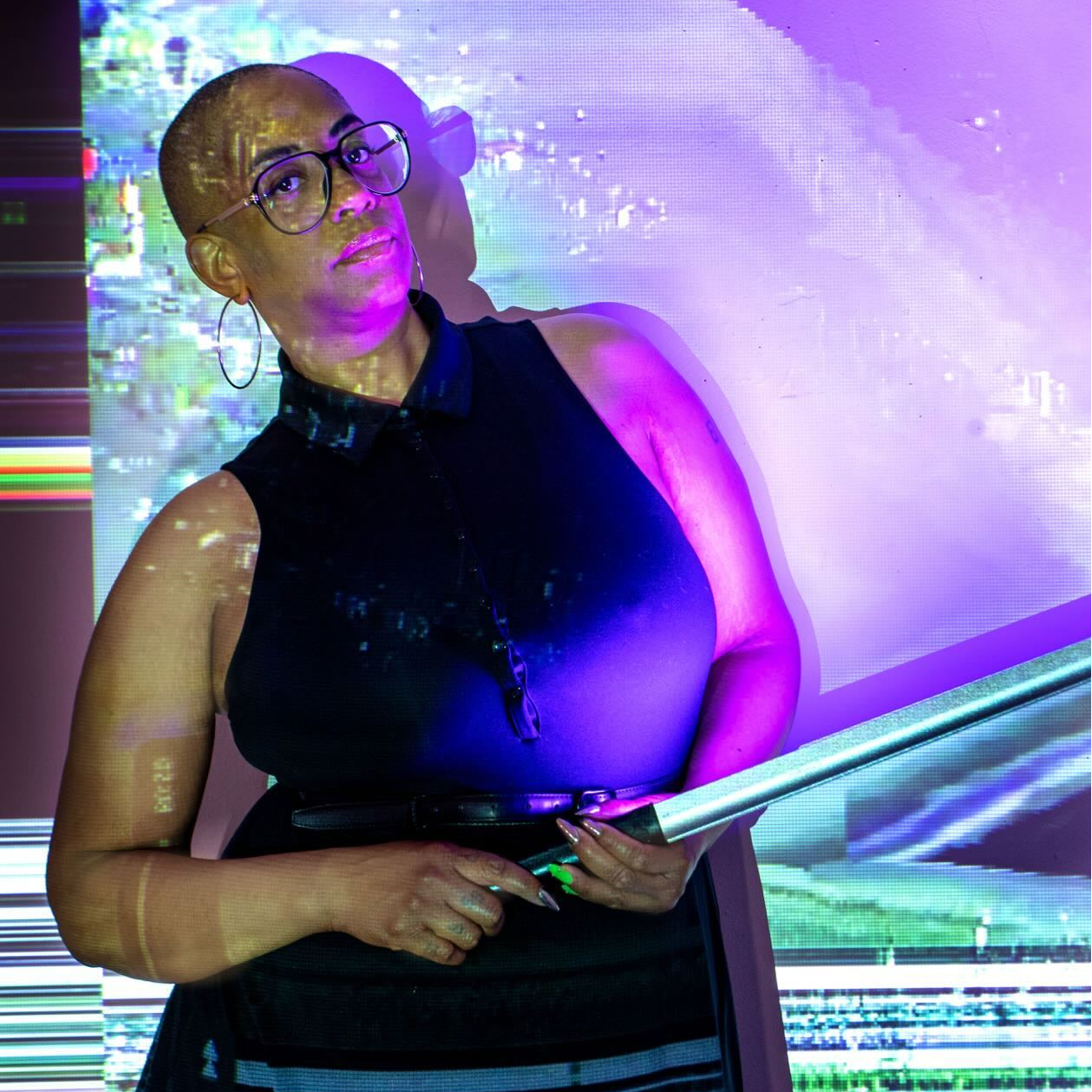
Seattle-based DJ and KEXP radio host Sharlese Metcalf is among the Emerald City’s most widely recognized selectors.
Sharlese began her career in radio in 2001 at Green River Community College, where she received her broadcasting certificate, and hosted Local Motion - a program focused on uplifting independent music from the PNW. As a host for KEXP she carried on her mission of sharing the best of the Northwest through Audioasis. Presently, she is the host of Mechanical Breakdown, and a rotating host of Expansions. She also works as the Producer of The Afternoon Show and Programming Education Manager of 90.TEEN - a program curated by Seattle’s youth.
In 2012, Sharlese stepped up to the decks of Seattle’s underground with the goth and industrial crew Second Sight. As she continued developing her sound for the dancefloor, she integrated further into the scene through the secondnature collective, TUF, and , as well as starting her own events: False Prophet, and Audiodrome.
Sharlese has earned a reputation as a DJ of the utmost integrity, dedicated to uplifting independent musicians, and delivering emotionally amplified sets across the world. As she approaches 25+ years of curating music, it’s a pleasure to share a peek into Ms. Metcalf’s perspective, alongside a live recording from Nowadays last February.
I’m curious what’s been most personally impactful in your time with KEXP?
I guess I’d say the fact that I’ve worked at KEXP for 19 years and they haven’t fired me yet! Hahaha.
But seriously, I love KEXP. I’ve been through every emotion possible there. I have family there. I’ve learned about myself—what I’m good at, what I’m not good at. In many ways, I grew up at KEXP.
What’s been most personally impactful is the development of who Sharlese is today and the way KEXP has nurtured every aspect of who I am throughout my professional career. I started out as an overnight fill-in DJ, then moved into the overnight slot, where I played a lot of witch house during those years :) After that, I moved into local music and worked on and hosted Audioasis for several years.
I really developed as a DJ, though, when I became a rotating host on Expansions. From there, I started Mechanical Breakdown. The structure and flow of Mechanical Breakdown are inspired by Expansions, except I talk a lot less on my show and really let the music speak for itself.
To get back to the question, what’s been personally impactful is that KEXP has given me the space to find my way—as a DJ, contributor, interviewer, and employee. It’s been a place where I’ve been able to grow into myself, both professionally and personally.
What do you feel radio is still offering people in 2026?
Radio is a listening experience. It’s a way of connecting with the curator, the DJ, and discovering new music. It can help you get through your day, keep you company, or even help you get things done. There’s something special about trusting the mix and letting someone else guide the journey. Sometimes it’s also about not feeling alone.
I don’t listen to commercial radio much anymore, so I’m not entirely sure what it sounds like these days. But I remember when I did. The commercial breaks felt like they lasted five minutes, and everything was very flashy. KEXP isn’t like that. I mean, we have some flashy stuff too :) but I feel like KEXP is more than a radio station.
We’re your nerdy friend who wants to talk about music and share music just as much as you do. That’s what makes it special. Radio is a unique experience you can give yourself. It’s a chance to discover something new, make a connection, and feel part of something larger than yourself.
Can you share some of the biggest changes you’ve witnessed in Seattle since you’ve been involved in the scene?
The scene is developing! I love what some of the younger promoters are doing, and it’s truly their own thing. I recently connected with Impact! Seattle, and I love that they’re creating something that feels completely unique. There are also some amazing parties happening at the Kremwerk complex.
There are so many new DJs with their own sound that goes beyond house and techno. Ghettotech and electro DJs are out there, blending really cool sounds and pushing things forward.
I’ll admit that I don’t get out enough because of my travel schedule, but shout out to SLIP aka Celine aka Cucci, Arel Watson at Kremwerk and Ethan Cory at Massive for sharing with me what I’m definitely missing out on. It’s interesting because Seattle is kind of tucked away in the corner of the U.S., so we can feel like a travel destination. But for the people who make it out here, I think we’re a good time.
What do you think needs more attention in the PNW?
I wish we had more infrastructure to support additional venue spaces where people could create, experiment, and build community. I also wish those spaces weren’t so spread out. I feel like because we don’t have a huge number of venues, we often end up going to the same places over and over again, which can make the scene feel smaller than it actually is.
At the same time, Seattle isn’t a massive city, so even me saying that is a little complicated because maybe the size of our scene is also connected to the size of the city itself. We’re not a city where you can have endless venues all over the place, but I think there’s still so much creativity happening here. It would just be amazing to have more spaces that allow different communities, sounds, and artists to grow.
I think the challenge is making sure there’s room for people to build something new without everything having to happen in the same few places. More spaces would mean more opportunities for different scenes to develop, and I think Seattle has the talent and creativity to support that.
Can you tell us a bit about your feature on Tending Tropic & Kay-Chi’s track Lightsaber?
LOL, it’s a funny track!
To be honest, I watch too many reels. I watched one about Sanrio characters and thought it was so cute and fun. Then I watched another about someone’s vinyl collection, and then another about pink fairies. Honestly, all of it just ended up in my brain and eventually found its way into my writing.
I feel like the writing I create is my mind going a mile a minute. It can mean a lot of things, and sometimes it means nothing at all. Sometimes it’s just me brain dumping. I learned about brain dumping in a creative writing class I took at Hugo House in Seattle on Capitol Hill. The lyrics are one big brain dump, a piece of abstract art.
I’m also a big fan of Farah from Italians Do It Better and Sophie Du Palais. I love their style and the way their voices sit on tracks. They’ve both been a huge source of inspiration for me.
I’ve been lucky enough to work with some really great producers who have nurtured my writing and encouraged my curiosity about putting my voice on tracks. Kay-Chi was the first person to ever ask me to do it, and I was really surprised by both the process and the outcome. I loved it.
But first and foremost, I’m a DJ. I love searching for music and discovering new and old things. I love sharing music and putting together a story. I love discovering sounds and learning about their history. I’m not a producer, and I don’t want to be a producer. Being a DJ is what I love, and I’m so lucky to have a radio show and be able to play club gigs. I get to explore, try new things, and see how everything connects, and that’s what brings me joy.
IYKYK: “...Lightsaber in one hand, I could be your savior.”
Can you share about your experience interviewing Jeff Mills last March?
Surreal! I still can’t believe it happened. It was funny because I prepared so much for that interview. I watched the movie, listened to the music he created for it, and watched and listened to interviews where he talked about the film. Then I got to the venue and realized this was actually happening. I was about to meet and interview a legend!
The best part was that he’s so passionate about his work and about the movie. He scored the film because he wanted to bring attention to its relevance and purpose in our world today, and because he believes that music in cinema is just as important as music that moves a dance floor.
I feel like this is one of my biggest accomplishments, something I never imagined would happen, and I’m really proud that I got to experience it.
What’s a piece of music history you wish more people knew?
This is something many of us in Seattle are just beginning to fully recognize, but what makes her story especially impactful to me is that I hosted the local music show for many years and never once knew Tina Bell existed. That realization was surprising and eye opening. It was also interesting to learn that grunge, a genre so often associated with white male artists, was shaped in part by a Black woman who played alongside some of the very musicians who are credited with defining its sound and culture.
As a Black woman who grew up in Seattle and often finds herself in predominantly white spaces, Tina's story means a lot to me. Her recognition feels important not only because of her contributions to music, but because it reminds us that there are still stories that have not been fully told and people whose impact deserves to be acknowledged.
What’s on the horizon for you?
I recently had a single from an EP come out on Bézier’s Body Tension label (aka Körperspannung Records) with Bruno Coviello. The next single will be released on July 9th, and the full EP drops on July 17th.
I’m also working on music with Radondo (Slow Motion / Wrong Era), although there’s no release date for that yet. I’m continuing to create with Kay-Chi and Tending Tropic <3
I’ve also been lightly working on some cool projects with Filmmaker and Ole Mic Odd, and I’m putting together a mix for DJ Stingray that will be coming out sometime in July.
I’m heading back to the EU soon to play some gigs, and there are a lot of exciting things happening that I’m really grateful for. Right now, I’m mostly focused on staying healthy while traveling, continuing to create, and figuring out my way through this wild world :)
For more from Sharlese, follow her here: